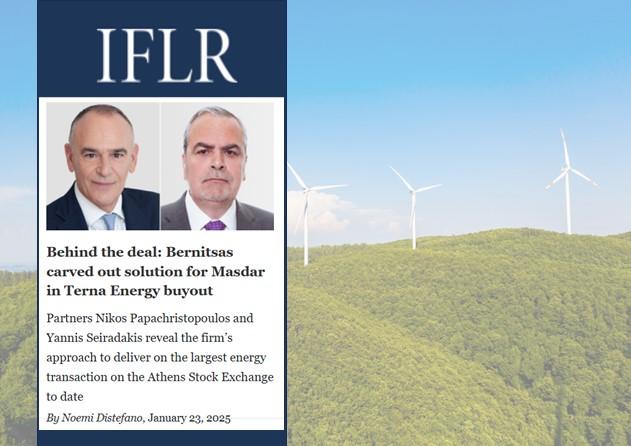
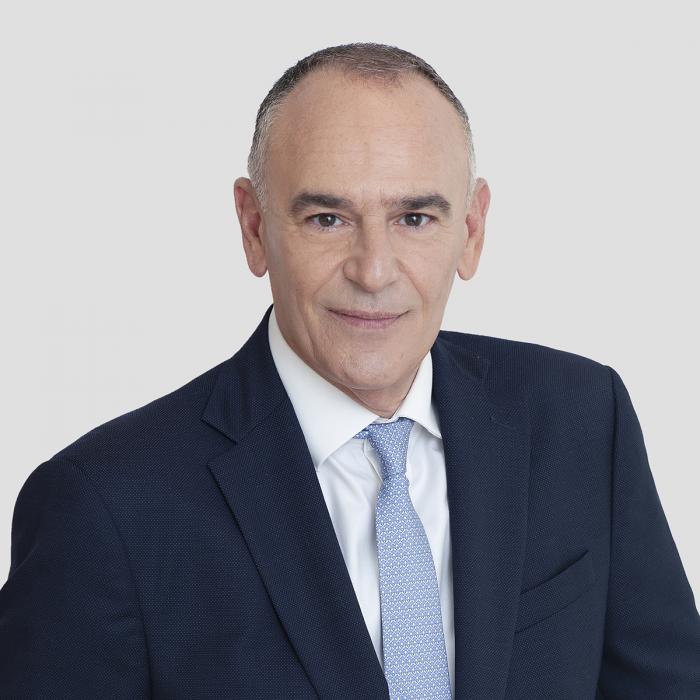
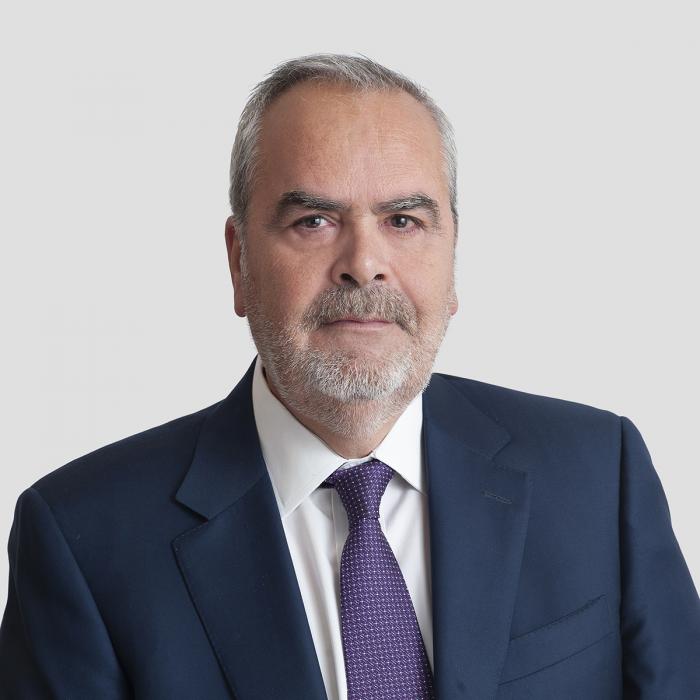
Nikos Papachristopoulos and Yannis Seiradakis were interviewed by Noemi Distefano for the 'Behind the deal' column on IFLR.com. The interview centered on the acquisition of TERNA ENERGY by Abu Dhabi Future Energy Company (Masdar), during which our Partners reflected on the challenging and innovative aspects of the transaction, its impact and discussed recent trends in the Athens Stock Exchange. This article was first published in IFLR by Noemi Distefano, on 23 January 2025. Read the interview here.
Behind the deal: Bernitsas carved out solution for Masdar in Terna Energy buyout
Partners Nikos Papachristopoulos and Yannis Seiradakis reveal the firm’s approach to deliver on the largest energy transaction on the Athens Stock Exchange to date
Bernitsas acted as Greek law counsel to Abu Dhabi Future energy Company PJSC – also known as Masdar – on the acquisition of 70% of the outstanding shares of Athens-listed company Terna Energy.
The €3.2 billion ($3.5 billion) deal, which spanned from September 2023 to November 2024, represents a step forward in the agreement between the UAE and Greece to strengthen ties on investment opportunities.
IFLR spoke with Bernitsas partners Nikos Papachristopoulos and Yannis Seiradakis to discuss how the firm won the deal, its innovative aspects and what it means for the firm’s future business.
What were the legally innovative aspects of the deal?
Papachristopoulos: Our involvement in this deal began in September 2023. Together with the financial adviser to Masdar, Rothschild & Co, and their international counsel, Simmons & Simmons, we started our work on a framework agreement and a proposal. This proposal was subsequently presented to the key shareholder of Terna Energy, GEK Terna.
An agreement in principle was reached on the main terms of the transaction. Following this, the legal, financial, technical and other teams started their work, culminating in the signing of a binding agreement in June 2024. The deal was ultimately completed at the end of November 2024, with Masdar acquiring a 70% stake of Terna Energy.
In terms of acquisition strategy and objectives, this transaction incorporated several innovative elements. First and foremost, the transaction was highly complex, and one of the primary goals was to ensure that the price agreed upon in June 2024 remained unchanged. This required a constructive and creative approach.
One significant challenge was that both parties had agreed the carve out of Terna Energy non-core assets from the transaction perimeter. These included the construction business, fibre optics and other assets, which were areas with which Masdar had limited familiarity. Such divestments needed to be conducted at arm’s length and without introducing undue risk to Terna Energy in its post-acquisition by Masdar.
The legal teams worked diligently to develop solutions that ensured the carve out of these assets would not affect the agreed price. The transaction was structured to leave Masdar and Terna Energy with minimal or no risk associated with these exclusions.
Seiradakis: I would also add that, as the target company, Terna Energy was part of the GEK Terna. This meant that there were several cooperation agreements in place between Terna Energy, the parent company and other members of the group, related to various key projects and areas. As part of the transaction, it was necessary to replace all these cooperation agreements to reflect Terna Energy’s exit from the parent company.
Additionally, and in parallel, we had to ensure the seamless continuation of the development of the various projects despite the organisation restructuring.
How did the firm win the deal?
Seiradakis: We had already worked with Masdar and their renewable projects team in the past on several projects. In addition to that, we had the experience of working with international firms and financial institutions that have an active presence in Greece – we were a natural fit for Masdar.
How was the deal team put together?
Papachristopoulos: As a law firm that has delivered several groundbreaking transactions in the Greek market, we were prepared to assemble a team which brought together lawyers from different practice areas. We fielded practitioners from our corporate, project and energy teams, litigation, finance and data protection teams among others. We had more than 20 lawyers working around the clock on this M&A transaction.
What challenges were encountered and how were they resolved?
Papachristopoulos: One of the key features of the deal was that it was conditional upon Masdar receiving at completion of the main transaction at minimum of 67% stake in Terna Energy.
That was key for two reasons. Firstly, because the party that holds the 67% may effectively decide on the passing of numerous significant corporate resolutions. Secondly, it was one of the requirements from our bank financiers to support the deal – not only to provide acquisition financing, but also to have additional lines available upon deal completion for the various operations of Terna Energy.
The way we achieved this – apart from our main agreements with GEK Terna – was securing irrevocable undertakings from other key shareholders of Terna Energy, including members of its executive team, institutions and other corporates, both international and domestic. Securing that 70% stake was a big challenge.
The due diligence process was extremely demanding. Yannis’s team had to review all the files of more than 600 projects.
Seiradakis: The portfolio of projects operated or developed by Terna Energy was huge – it included solar, wind, hydro, hydro- pump, biomass, and all types of conventional and renewable energy projects, even hydrocarbons and offshore wind parts.
There were 50 subsidiary companies involved in these renewables projects with their own financing arrangements and with their third-party providers contracts – it was a challenging exercise.
How has the deal helped the firm win more work?
Papachristopoulos: This deal has attracted huge publicity, and its successful closing is a great confirmation of our expertise in advising our clients to successfully deliver complex market transactions. We look forward to having the opportunity to work on similar deals in the future.
How does the firm plan to expand its focus on the energy and renewables sector?
Seiradakis: Our practice in the energy sector covers all types of energy, from electricity to renewable energy, and carbon capture storage to conventional energy. Local and foreign investors and well-known companies choose our firm as their legal advisers in this specific sector. We are expanding our team and we remain optimistic that our business will continue to increase.
What trends do you expect to see in the Athens Stock Exchange – and do you expect increased IPO activity over the next 12 months?
Papachristopoulos: The Greek stock market is very active, but of course it remains vulnerable to outside factors. At Bernitsas, we are currently working on two other IPOs which should conclude between the first and the second quarter of this year.
For debt, we expect increased activity as a number of listed bonds come to maturity and need to be refinanced. In addition to that, the Greek government has announced a new bill which aims to further strengthen the Greek capital markets and the Athens Stock Exchange by providing tax and other incentives, to attract not only international investors, but also domestic local companies.
IFLR.com covers financial regulation, M&A, ESG and related areas with a ‘business of law’ legal lens. They provide critical insight into how regulatory changes and developments in the legal sector affect law firms’ operations and strategies.